When we recommend Odoo
When you need richer interfaces, a large app marketplace (80+ apps), and commercial support behind the system, and you’re ready to trade licence cost for product maturity.
Explore Odoo implementation
Most companies sell you the system they hold the licence for. We implement both Odoo and ERPNext and take a commission from neither, so we can tell you the truth: each system has its ideal case, and the recommendation comes after we look at your operations, not before.
We do not force every business into the same ERP.
We look at your workflows, team size, growth plans, required integrations and budget before recommending a platform.
A practical comparison across 8 axes — from a team that implements both, not a vendor of one.
When you need richer interfaces, a large app marketplace (80+ apps), and commercial support behind the system, and you’re ready to trade licence cost for product maturity.
Explore Odoo implementationWhen you want a fully open-source system with no per-user licence fees, total cost falls sharply as your team grows, with deep customisation for businesses with specific needs and disciplined budgets.
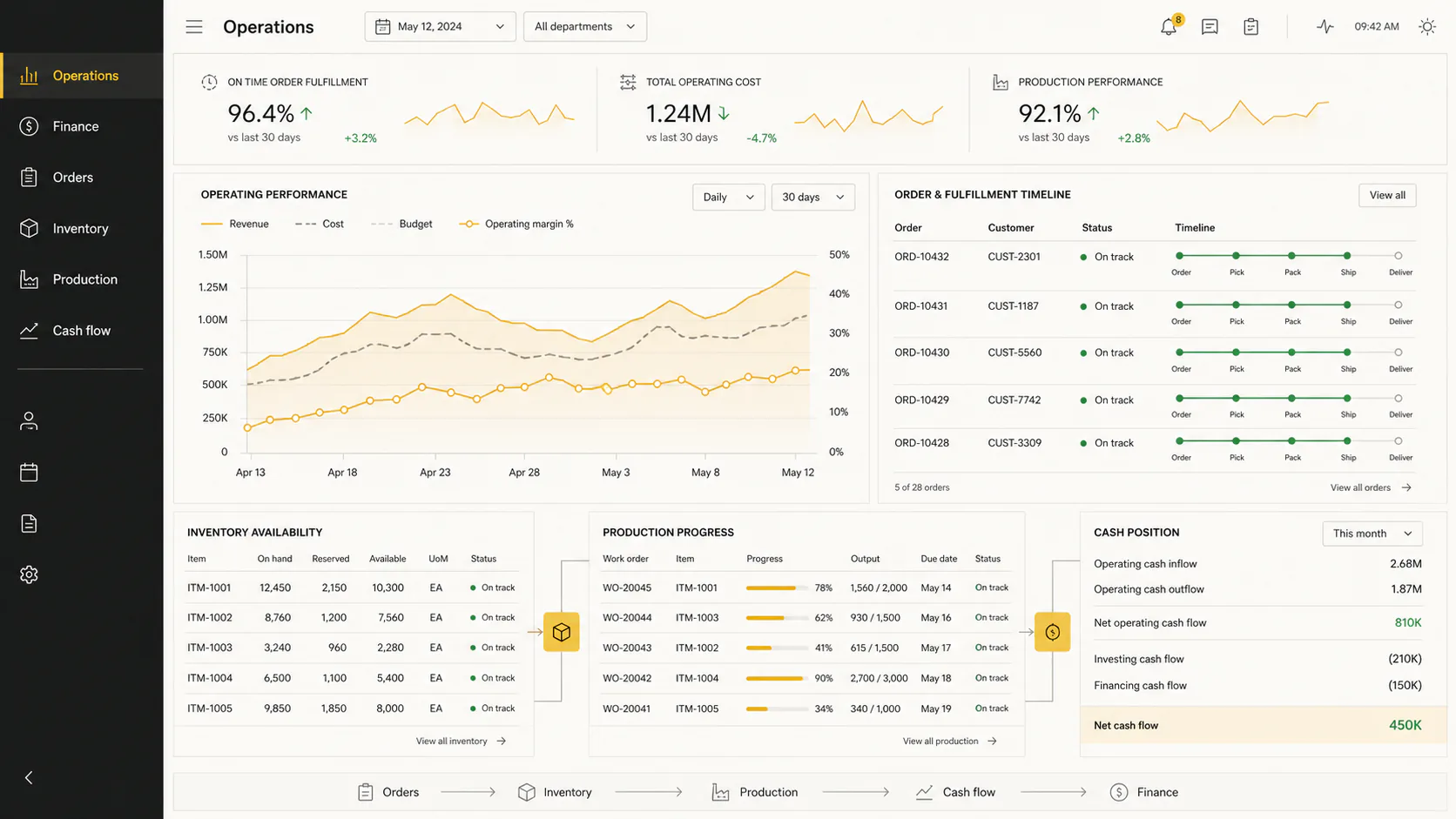
Explore ERPNext implementationOne clear operating flow from the first lead to the final report.
We prepare both systems for full compliance: ZATCA integration for Saudi businesses across both phases, and the Egyptian Tax Authority e-invoicing system. This is mandatory work that leaves no room for improvisation, and our experience is practical, not theoretical.
Both ZATCA phases for Saudi businesses — a mandatory item that leaves no room for improvisation.
Egyptian Tax Authority integration — our experience here is practical, not theoretical.
Six stages with binding deliverables: qualification, proposal and contract (with an advance payment that protects both parties’ commitment), kick-off with a scope document, delivery in two-week cycles with a weekly report, handover with documented training, then annual support.
We confirm the project fits both sides before any commitment.
An advance payment protects both parties’ commitment.
Exactly what will be delivered, documented in writing.
Visible progress with a clear weekly report.
Your team runs the system themselves.
Life after launch is planned from day one.

Our actual projects gave rise to ready solutions you can deploy quickly: they cut months of customisation and get you live sooner.
Point of sale and inventory connected to accounting in real time.
Items, expiry dates, and prescriptions — with sector-specific controls.
Units, contracts, and collection in a single cycle.
Direct answers to the practical questions that shape an ERP project.
Usually 4–12 weeks, depending on scope. We confirm the schedule after the diagnostic session and document it in the scope.
You receive a detailed proposal after the diagnostic session. Cost depends on the number of users, required modules, customisation, and integrations.
Yes. Handover includes documented training until your team can run the system independently, with optional support under an annual contract.
Yes. Cleaning, reviewing, and migrating the data are part of our methodology, so old errors do not move into the new system.
A free 30-minute assessment. You leave with a two-page report covering your top three gaps, where to start, and a first effort estimate. No commitment.
Book your free assessment